Thursday, August 7, 2008

The Merchant's Tale Prologue


Photo credit: Special thanks to http://www.bl.uk/onlinegallery/

========= SensUal Joy =========

'Weeping and wailing, care and other sorrow,
I know them well enough by eve and morrow,'

The Merchant said;' like others I suppose

That have been married, that's the way it goes;


I know too well that's how it goes with me.
I have a wife, the worst that there could be;
For if a fiend were coupled to my wife,

She'd overmatch him, you can bet your life.

Love Program

Why choose a special instance to recall

Her soaring malice? She's a shrew in all.

There's a wide difference I'm bound to say

Between Griselda's patience and the way


My wife behaves; her studied cruelty

Surpasses everything. If I were free,

Never again, never again the snare!

Love Program

We married men, our life is grief and care.

Try it who will, and he will find, I promise

That I have spoken truly, St Thomas,

For most of us - I do not say for all,

And God forbid that such a thing befall.


'Ah, my good Host, I have been wedded now

These two months past, no more than that, I vow,

Yet I believe no bachelor alive,

Not if you were to take a knife and rive

Him to the heart, could tell of so much grief

As I could tell you of; beyond belief,

The curst malignity I get from her!'

Love Program

Our Host replied,' God bless you, my dear sir!

But since you know so much about the art

Of marriage, let me beg you to impart.'

'With pleasure,' he said,' but on the personal score
I'm so heart-scalded I shall say no more.'

- Penguin Classics
Geoffrey Chaucer
Edited by Nevill Coghill

Meanwhile, do check out Way Back Into Love (WBIL) if you want to enjoy a Happier, Healthier and more SensUal way of life!

Need a edgier program? Go for Kick Ass Girl (KSG) then!

Wednesday, August 6, 2008

The Wife of Bath's Tale


When good King Arthur ruled in ancient days
(A king that every Briton loves to praise)
This was a land brim-full of fairy folk.

The Elf-Queen and her courtiers joined and broke
Their elfin dance on many a green mead,
Or so was the opinion once, I read,
Hundreds of years ago, in days of yore.

Love Program

But no one now sees fairies any more.
For now the saintly charity and prayer
Of holy friars seem to have purged the air;
They search the countryside through field and stream
As thick as motes that speckle a sun-beam,
Blessing the halls, the chambers, kitchens, bowers,
Cities and boroughs, castles, courts and towers,
Thorpes, barns and stables, outhouses and dairies,
And that's the reason why there are no fairies.
Whenever there was wont to walk an elf
To-day there walks the holy friar himself

As evening falls or when the daylight springs,
Saying his mattins and his holy things,
Walking his limit round from town to town.

Love Program

Women can now go safely up and down
By every bush or under every tree;
There is no other incubus but he,
So there is really no one else to hurt you
And he will do more than take your virtue.

Now it so happened, I began to say,
Long, long ago in good King Arthur's day.
There was a knight who was a lusty liver.

Love Program

One day as he came riding from the river
He saw a maiden walking all forlorn
Ahead of him, alone as she was born.

And of that maiden, spite of all she said,
By very force, he took her maidenhead.
This act of violence made such a stir,
So much petitioning to the king for her,
That he condemned the knight to lose his head
By course of law. He was as good as dead
(It seems that then the statutes took that view)

Love Program

But that the queen, and other ladies too,
Implored the king to exercise his grace
So ceaselessly, he gave the queen the case
And granted her his life, and she could choose
Whether to show him mercy or refuse.

The queen returned him thanks with all her might,
And then she sent a summons to the knight
At her convenience, and expressed her will:
'You stand, for such is the position still,
In no way certain of your life,' said she,
'Yet you shall live if you can answer me:
What is the thing that women most desire?
Beware the axe and say as I require.

Love Program

'If you can't answer on the moment, though,
I will concede you this: you are to go
A twelvemonth and a day to seek and learn
Sufficient answer, the you shall return.

I shall take gages from you to extort
Surrender your body to the court.'
Sad was the knight and sorrowfully sighed,
But there! All other choices were denied,
And in the end he chose to go away
And to return after a year and day
Armed with such answer as there might be sent
To him by God. He took his leave and went.

Love Program

He knocked at every house, searched every place,
Yes, anywhere that offered hope of grace.
What could it be that women wanted most?
But all the same he never touched a coast,
Country or town in which there seemed to be
Any two people willing to agree.

Some said that women wanted wealth and treasure,
'Honour,' said some, some 'Jollity and pleasure,'
Some 'Gorgeous clothes' and others "Fun in bed,'
'To be oft widowed and remarried,' said
Others again, and some that what most mattered
Was that we should be cosseted and flattered.

Love Program

That's very near the truth, it seems to me;
A man can win us best with flattery.
To dance attendance on us, make a fuss,
Ensnares us all, the best and worst of us.

Some say the things we most desire are these:
Freedom to do exactly as we please,
With no one to reprove our faults and lies,
Rather to have one call us good and wise.

Love Program

Truly there's not a woman in ten score
Who has a fault, and someone rubs the sore,
But she will kick if what he says is true;
You try it out and you will find so too.

However vicious we may be within
We like to be thought wise and void of sin.
Others assert we women find it sweet
When we are thought dependable, discreet
And secret, firm of purpose and controlled,
Never betraying things that we are told.

Love Program

But that's not worth the handle of a rake;
Women conceal a thing? For Heaven's sake!
Remember Midas? Will you hear the tale?

Among some other little things, now stale,
Ovid relates that under his long hair
The unhappy Midas grew a splendid pair
Of ass's ears; as subtly as he might,

Love Program

He kept his foul deformity from sight;
Save for his wife, there was not one that knew.
He loved her best, and trusted in her too.

He begged her not to tell a living creature
that he possessed so horrible a feature.
And she - she swore, were all the world to win.
She would not do such villiany and sin
As saddle her husband with so foul a name;

Love Program

Besides to speak would be to share the shame.
Nevertheless she thought she would have died
Keeping this secret bottled up inside;
It seemed to swell her heart and she, no doubt,
Thought it was on the point of bursting out.

Fearing to speak of it to woman or man,
Down to a reedy marsh she quickly ra
And reached the sedge. Her heart was all on fire
And, as a bittern bumbles in the mire,
She whispered to the water, near the ground,

Love Program

'Betray me not, O water, with thy sound!
To thee alone I tell it: it appears
My husband has a pair of ass's ears!
Ah! My heart's well again, the secret's out!

I could no longer keep it, not a doubt.'
And so you see, although we may hold fast
A little while, it must come out at last,
We can't keep secrets; as for Midas, well,
Read Ovid for his story; he will tell.

Love Program

This knight that I am telling you about
Perceived at last he never would find out
What it could be that women loved the best.

Faint was the soul within his sorrowful breast,
As home hw went, he dared no longer stay;
His year was up and now it was the day.

Love Program

As he rode home in a dejected mood
Suddenly, at the margin of a wood,
He saw a dance upon the leafy floor
Of four and twenty ladies, nay, and more.

Eagerly he approached, in hope to learn
Some words of wisdom ere he should return;
But lo! Before he came to where they were,
Dancers and dance all vanished into air!

Love Program

There wasn't a living creature to be seen
Save one old woman crouched upon the green.
A fouler-looking creature I suppose
Could scarcely be imagined. She arose
And said,' Sir knight, there's no way on from here.
Tell me what you are looking for, my dear,
For peradventure that were best for you;
We old, old women know a thing or two.'

'Dear Mother,' said the knight,' alack the day!
I am as good as dead if I can't say
What thing it is that women most desire;
If you could tell me I would pay your hire.'

Love Program

'Give me your hand,' she said,' and swear to do
Whatever I shall next require of you
- If so to do should lie within your might -
And you shall know the answer before night.'

'Upon my honour,' he answered,' I agree.'
'Then,' said the crone,' I dare to guarantee
Your life is safe; I shall make good my claim.
Upon my life the queen will say the same.

Love Program

Show me the very proudest of them all
In costly coverchief or jewelled caul
That dare say no to what I have to teach.
Let us go forward without further speech.'

And then she crooned her gospel in his ear
And told him to be glad and no to fear.

Love Program

They came to court. This knight, full of array.
Stood forth and said,' O Queen, I've kept my day
And kept my word and have my answer ready.'

There sat the noble matrons and the heady
Young girls, and widows too, that have the grace
Of wisdom, all assembled in that place,

Love Program

And there the queen herself was throned and hear
And judge his answer. Then the knight drew near
And silence was commanded through the hall.

The queen gave order he should tell them all
What thing it was that women wanted most.
He stood not silent like a beast or post,
But gave his answer with the ringing word
Of a man's voice and the assembly heard:

Love Program

'My liege and lady, in general,' said he,
'A woman wants the same sovereignty
Over her husband as over her lover,
And master him; he must not be above her
That is your greatest wish, whether you kill
Or spare me; please yourself. I wait your will.'

In all the court not one that shook her head
Or contradicted what the knight had said;
Maid, wife and widow cried,' He's saved his life!'

Love Program

And on the word up started the old wife,
The one the knight saw sitting on the green,
And cried,' Your mercy, sovereign lady queen!
Before the court disperses, do me right!

'Twas I who taught this answer to the knight,
For which he swore, and pledged his honour to it,
That the first thing I asked of him he'd do it,
So far as it should lie within his might.

Love Program

Before this court I ask you then, sir knight,
To keep your word and take me for your wife;
For well you know that I have saved your life.
If this be false, deny it on your sword!'

'Alas!' He said,' Old lady, by the Lord
I have know indeed that such was my behest,
But for God's love think of a new request,
Take all my goods, but leave my body free.'

Love Program

'A curse on us,' she said,' if I agree!
I may be foul, I may be poor and old,
Yet will not choose to be, for all the gold
That's bedded in the earth or lies above,
Less than your wife, nay, than your very love!'

'My love?' said he. By heaven, my damnation!
Alas that any of my race and station
Should ever make so foul a misalliance!

Love Program

Yet in the end his pleading and defiance
All went for nothing, he was forced to wed.
He takes his ancient wife and goes to bed.

Now peradventure some may well suspect
A lack of care in me since I neglect
To tell of the rejoicing and display
Made at the feast upon their wedding-day.
I have but a short answer to let fall;
I say there was no joy or feast at all,
Nothing but heaviness of heart and sorrow.

Love Program

He married her in private on the morrow
And all day long stayed hidden like an ow,
It was such torture that his wife looked foul.

Great was the anguish churning in his head
When he and she were piloted to bed;
He wallowed back and forth in desperate style.

Love Program

His ancient wife lay smiling all the while;
At last she said,' Bless us! Is this, my dear,
How knights and wives get on together here?

Are these the laws of good King Arthur's house?
Are knights of his all so contemptuous?
I am your own beloved and your wife,
And I am she, indeed, that saved your life;
And certainly I never did you wrong.

Love Program

Then why, this first of nights, so sad a song?
You're carrying on as if you were half witted.
Say for God's love, what sin have I committed?

I'll put things right if you will tell me how.'
'Put right?' he cried. 'That never can be now!
You're old, and so abominably plain,
So poor to start with, so low-bred to follow;

Love Program

It's little wonder if I twist and wallow!
God, that my heart would burst within my breast!'

'Is that,' said she,' the cause of your unrest?'
'Yes, certainly,' he said,' and can you wonder?'
'I could set right what you suppose a blunder,
That's if I cared to, in a day or two,
If I were shown more courtesy by you.

Love Program

Just now,' she said,' you spoke of gentle birth,
Such as descends from ancient wealth and worth.
If it's the claim you make for gentlemen
Such arrogance is hardly worth a hen.

Whoever loves to work for virtuous ends,
Public and private, and who most intends
To do what deeds of gentleness he can,
Take him to be the greatest gentleman.

Love Program

Christ wills we take our gentleness from Him,
Not from a wealth of ancestry long dim,
Though they bequeath their whole establishment
By which they claim to be of high descent.

Our fathers cannot make us a bequest
Of all those virtues that became them best
And earned for them the name of gentlemen,
And bade us follow them as best as we can,

Love Program

'Thus the wise poet of the Florentines,
Dante by name, has written in these lines,
For such is the opinion Dante launches;
"Seldom arises by these slender branches
Prowess of men, for it is God, no less,
Wills us to claim of Him our gentleness."

For of our parents nothing can we claim
Save temporal things, and these may hurt and maim.
'But everyone knows this as well as I;

Love Program

For if gentility were implanted by
The natural course of lineage down the line,
Public and private, could it cease to shine
In doing the fair work of gentle deed?
No vice or villainy could then bear seed.

'Take fire and carry it to the darkest house
Between this kingdom and the Caucasus,
And shut the doors on it and leave it there,
It will burn on, and it will burn as fair

Love Program

As if ten thousand men were there to see,
For fire will keep its nature and degree,
I can assure you, sir, until it dies.

'But gentleness, as you will recognize,
Is not annexed in nature to possessions.
Men fail in living up to their professions;
But fire never ceases to be fire.

Love Program

God knows you'll often find, if you enquire,
Some lording full of villainy and shame.
If you would be esteemed for the mere name
Of having been by birth a gentleman

And stemming from some virtuous, noble clan,
And do not live yourself by gentle deed
Or take your father's noble code and creed.
You are no gentleman, though duke or earl.
Vice and bad manners are what make a churl.

Love Program

'Gentility is only the reown
For bounty that your fathers handed down,
Quite foreign to your person, not your own;
Gentility must come from God alone.

That we are gentle comes to us by grace
And by no means is it bequeathed with place.

Love Program

'Reflect how noble (says Valerius)
Was Tullius surnamed Hostilius,
Who rose from poverty to nobleness.

And read Boethius, Seneca no less,
Thus they express themselves and are agreed:
"Gentle is he that does a gentle deed."

Love Program

And therefore, my dear husband, I conclude
That even if my ancestors were rude,
Yet God on high - and so I hope He will -
Can grant me grace to live in virtue still,
A gentlewoman only when beginning
To live in virtue and to shrink from sinning.

'As for my poverty which you reprove
Almighty God Himself in whom we move,
Believe and have our being, chose a life
Of poverty, and every man or wife
Nay, every child can see our Heavenly King
Would never stoop to choose a shameful thing.

Love Program

No shame in poverty if the heart is gay,
As Seneca and all the learned say.
He who accepts his poverty unhurt
I'd say is rich although he lacked a shirt.

But truly poor are they who whine and fret
And covet what they cannot hope to get.
And he that, having nothing, covets not,
Is rich, though you may think he is a sot.

Love Program

'True poverty can find a song to sing.
Juvenal says a pleasant little thing:
"The poor can dance and sing in the relief
Of having nothing that will tempt a thief."

Though it be hateful, poverty is good,
A great incentive to a livelihood
And a great help to our capacity
For wisdom, if accepted patiently.

Love Program

Poverty is, though wanting in estate,
A kind of wealth that none calumniate.
Poverty often, when the heart is lowly,
Brings one to God and teaches what is holy,
Gives knowledge of oneself and even lends
A glass by which to see one's truest friends.

And since it's no offence, let me be plain;
Do not rebuke my poverty again.

Love Program

'Lastly you taxed me, sir, with being old.
Yet even if you never had been told
By ancient books, you gentlemen engage,
Yourselves in honour to respect old age.

To call an old man "father" shows good breeding,
And this could be supported from my reading.

Love Program

'You say I'm old and fouler than a fen.
You need not fear to be a cuckold, then.
Filth and old age, I'm sure you will agree,
Are powerful wardens over chastity.

Nevertheless, well knowing your delights,
I shall fulfil your worldly appetites.

Love Program

'You have two choices; which one will you try?
To have me old and ugly till I die,
But still a loyal, true, and humble wife
That never will displease you all her life,

Or would you rather I were young and pretty
And chance your arm what happens in a city
Where friends will visit you because of me,
Yes, and in other places too, maybe.
Which would you have? The choice is all your own.'

Love Program

The knight thought long, and with a piteous groan
At last he said, with all the care in life,
'My lady and my love, my dearest wife,
I leave the matter to your wise decision.

You make the choice yourself, for the provision
Of what may be agreeable and rich
In honour to us both, I don't care which;
Whatever pleases you suffice me.'

Love Program

And have I won the mastery? said she,
'Since I'm to choose and rule as I think fit?'
'Certainly, wife,' he answered her,' that's it.'

'Kiss me,' she cried. 'No quarrels! On my oath
And word of honour, you shall find me both,
That is, both fair and faithful as a wife;
May I go howling mad and take my life
Unless I prove to be as good and true
As ever wife was since the world was new!

Love Program

And if to-morrow when the sun's above
I seem less fair than any lady-love.
Than any queen or empress east or west,
Do with my life and death as you think best.
Cast up the curtain, husband. Look at me!'

And when indeed the knight had looked to see,
Lo, she was young and lovely, rich in charms.
In ecstasy he caught her in his arms,
His heart went bathing in a bath of blisses
And melted in a hundred thousand kisses,
And she responded in the fullest measure
With all that could delight or give him pleasure.

Love Program

So they lived ever after to the end
In perfect bliss; and may Christ Jesus send
Us husbands meek and young and fresh in bed,
And grace to overbid them when we wed.

And - Jesu hear my prayer! - cut short the lives
Of those who won't be governed by their wives;
And all old, angry niggards of their pence,
God send them soon a very pestilence!

- Penguin Classics
Geoffrey Chaucer
Edited by Nevill Coghill

Meanwhile, do check out Way Back Into Love (WBIL) if you want to enjoy a Happier, Healthier and more SensUal way of life!

Need a edgier program? Go for Kick Ass Girl (KSG) then!
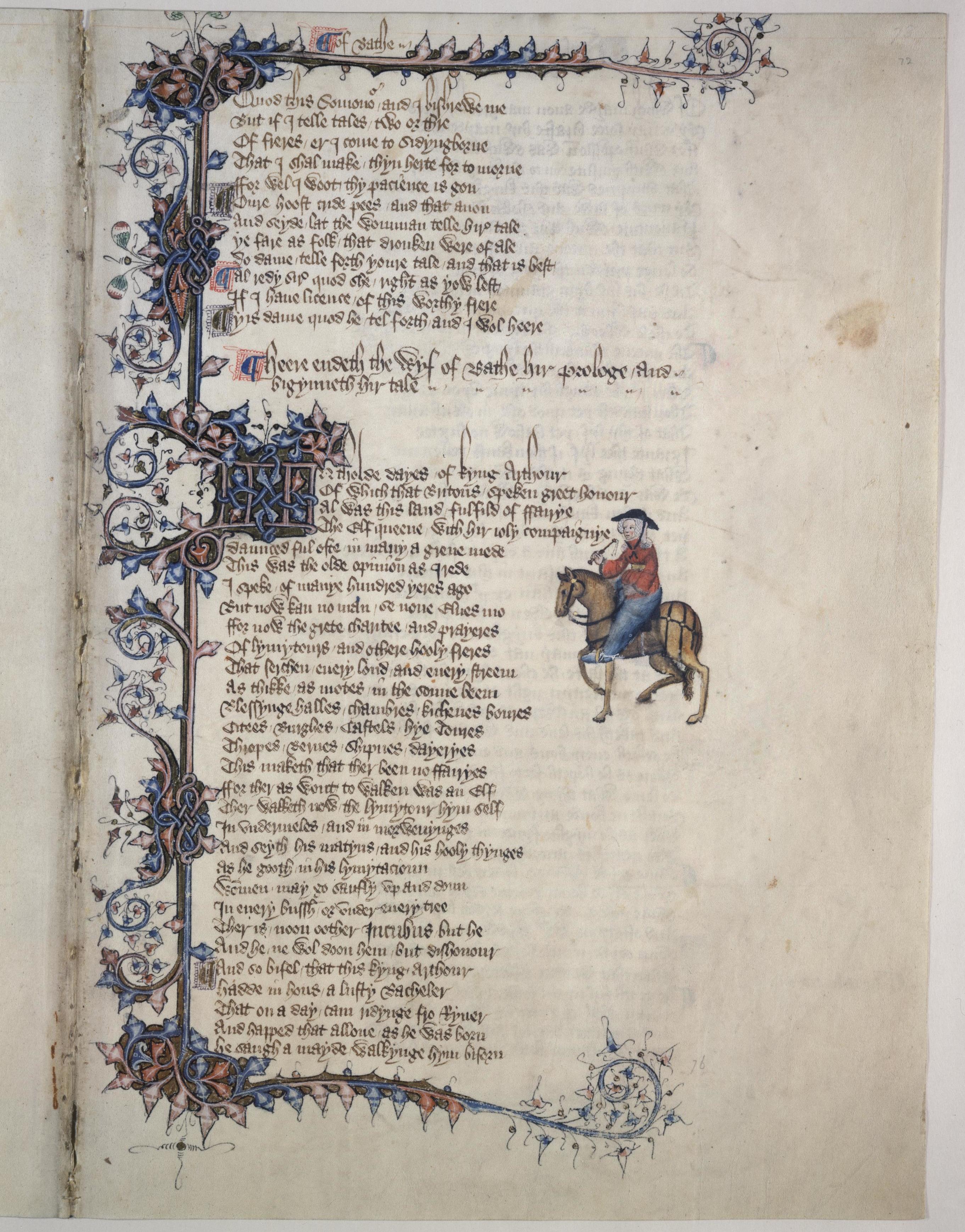
Words between the Summoner and the Friar (The Wife of Bath's Tale)

The Friar laughed when he had heard all this.
'Well, Ma'am,' he said," as God may send me bliss,
This is a long preamble to a tale!"

But when the Summoner heard the friar rail,
'Just look!' he cried,' by the two arms of God!
These meddling friars are always on the prod!
Don't we all know a friar and a fly
Go prod and buzz in every dish and pie!

Love Program

What do you mean with your 'preambulation"?
Amble yourself, trot, do a meditation!
You're spoiling all our fun with your commotion.'

The Friar smiled and said," Is that your motion?
I promise on my word before I go
To find occasion for a tale or so
About a summoner that will make us laugh.'

Love Program

'Well, damn your eyes, and on your own behalf,'
The Summoner answered,' mine be damned as well
If I can't think of several tales to tell
About the friars that will make you mourn
Before we get as far as Sittingbourne.
Have you no patience? Look, he's in a huff!'

Our Host called out,' Be quiet, that's enough!
Shut up, and let the woman tell her tale.
You must be drunk, you've taken too much ale.
Now Ma'am, you go ahead and no demur.'
'All right,' she said,' It's just as you prefer,
If I have licence from this worthy friar.'
'Nothing,' said he,' that I should have more desire.'

- Penguin Classics
Geoffrey Chaucer
Edited by Nevill Coghill

Meanwhile, do check out Way Back Into Love (WBIL) if you want to enjoy a Happier, Healthier and more SensUal way of life!

Need a edgier program? Go for Kick Ass Girl (KSG) then!

Tuesday, August 5, 2008

The Wife of Bath's Prologue

'If there were no authority on earth
Except for experience, mine, for what it's worth,
And that's enough for me, all goes to show
That marriage is a misery and a woe;
For let me say, if I may make so bold,
My lord, since when i was but twelve years old,
Thanks be to God Eternal evermore,
Five husbands have I had at the church door;
Yes, it's a fact that I have had so many,
All worthy in their way, as good as any.

Love Program

"Someone said recently for my persuasion
That as Chris only went on one occasion
To grace a wedding - in Cana of Galilee -
He taught me by example there to see

That it is wrong to marry more than once.
Consider, too, how sharply, for the nonce,
He spoke, rebuking the Samaritan
Beside the well, Christ Jesus, God and man.

"Thou has had five men husband unto thee
And he that even now thou hast," said He,
"Is not thy husband." Such he words that fell;
But what He meant thereby I cannot tell.

Why was her fifth - explain it if you can
No lawful spouse to the Samaritan?
How many might have had her, then, to wife?
I've never head an answer all my life
To give the number final destination.

People may guess or frame a supposition,
But I can say for certain, it's no lie,
God bade us all to wax and multiply.
That kindly text I well can understand.
Is not my husband under God's command
To leave his father and mother and take me?

No word of what the number was to be,
Then why not marry two or even eight?
And why speak evil of the married state?

'Take wise King Solomon of long ago;
We hear he had a thousand wives or so.
And would to God it were allowed to me
To be refreshed, aye, half so much as he!
He must have had a gift of God for wives,
No one to match him in a world of lives!

This noble king, one may as well admit,
On the first night threw many a merry fit
With each of them, he was so much alive.
Blessed be God that I have wedded five!

Welcome the sixth, whenever he appears.
I can't keep continent for years and years.
No sooner than one husband's dead and gone
Some other Christian man shall take me on,
For then, so says the Apostle, I am free
To wed, o'God's name, where it pleases me.

Wedding's no sin, so far as I can learn.
Better it is to marry than to burn.
"What do I care if people choose to see
Scandal in Lamech for his bigamy?

I know that Abraham was a holy man
And Jacob too - I speak as best I can
Yet each of them, we know, had several brides
Like many another holy man besides.

Love Program

Show me a time or text where God disparages
Or sets a prohibition upon marriages
Expressly, let me have it! Show it to me!
And where did He command virginity?

I know as well as you do, never doubt it,
All the Apostle Paul had said about it;
He said that as for precepts he had none.
One may advise a woman to be one;
Advice is no commandment in my view.
He left it in our judgment what to do.
"Had God commanded maidenhood to all
Marriage would be condemned beyond recall,
And certainly if seed were never sown,
How ever could virginity be grown?
Paul did not dare pronounce, let matters rest,
His Master having given him no behest,
There's a prize offered for virginity;
Catch as catch can! Who's in for it? Let's see!
"It is not everyone who hears the call;
On whom God wills He lets His power fall.
The Apostle was a virgin, well I know;
Nevertheless, though all his writings show
He wished that everyone were such as he,
It's all mere counsel to virginity.
And as for being married, he lets me do it
Out of indulgence, so there's nothing to it
In marrying me, suppose my husband dead;
There's nothing bigamous in such a bed.
Though it were good a man should never touch
A woman (meaning here in bed and such)
And dangerous to assemble fire and tow
- What this allusion means you all must know -
He only says virginity is fresh,
More perfect than the frailty of the flesh
In married life - except when he and she
Prefer to live in married chastity.
"I grant it you. I'll never say a word
Decrying maidenhood although preferred
To frequent marriage; there are those who mean
To live in their virginity, as clean
In body as in soul, and never mate.
I'll make no boast about my own estate.
As in noble household, we are told,
Not every dish and vessel's made of gold,
Some are of wood, yet earn their master's praise,
God calls his folks to him in many ways.
To each of them God gave His proper gift,
Some this, some that, and left them to make shift.
Virginity is indeed a great perfection,
And married continence, for God's dilection,
But Christ, who of perfection is the well,
Bade not that everyone should go and sell
All that he has and give it to the poor
To follow in His footsteps, that is sure.
He spoke to those that would live perfectly,
And by your leave, my lords, that's not fo rme.
I will bestow the flower of life, the honey,
Upon the acts and fruit of matrimony.

"Tell me to what conclusion or in aid
Of what were generative organs made?
And for what profit were those creatures wrought?
Trust me, they cannot have been made for naught.

Gloze as you will and plead the explanation
That they were only made for purgation
Or urine, little things of no avail
Except to know a female from a male,
And nothing else. Did somebody say no?

Love Program

Experience knows well it isn't so.
The learned may rebuke me, or be loth
To think it so, but they were made for both,
That is to say both use and pleasure in
Engendering, except in case of sin.

Why else the proverb written down and set
In books: "A man must yield his wife her debt"?
What means of paying her can he invent
Unless he use his silly instrument?

It follows they were fashioned at creation
Both to purge urine and for propagation.
"But I'm not saying everyone is bound
Who has such harness as you heard me expound
To go and use it breeding; that would be
To show too little care for chastity.
Christ was a virgin, fashioned as a man,
And many of his saints since time began
Were ever perfect in their chastity.

I'll have no quarrel with virginity.
Let them be pure wheat loaves of maidenhead
And let us wives be known for barley-bread;
Yet Mark can tell that barley-bread sufficed
To freshen many at the hand of Christ.

In that estate to which God summoned me
I'll persevere; I'm not pernickety.
In wifehood I will use my instrument
As freely as my Maker me it sent.
If I turn difficult, God give me sorrow!

My husband, he shall have it eve and morrow
Whenever he likes to come and pay his debt,
I won't prevent him! I'll have a husband yet
Who shall be both my debtor and my slave
And bear his tribulation to the grave

Upon his flesh, as long as I'm his wife.
For mine shall be the power of his life
Over his proper body, and not he,
Thus the Apostle Paul has told it me,
And bade our husbands they should love us well;
There's a command on which I like to dwell..."

The Pardoner started up, and thereupon
"Madam," he said, "by God and by St John,
That's noble preaching no one could surpass!
I was about to take a wife; alas!

Am I to buy it on my flesh so dear?
There'll be no marrying for me this year!"
"You wait," she said," my story's not begun.
You'll taste another brew before I've done;
You'll find it doesn't taste as good as ale;
And when I've finished telling you my tale
Of tribulation in the married life
In which I've been an expert as a wife,
That is to say, myself have been the whip.
So please yourself whether you want to sip
At the same cask of marriage I shall broach.
Be cautious before making the approach,
For I'll give instances, and more than ten.
And those who won't be warned by other men,
By other men shall suffer their correction,
So Ptolemy has said, in this connection.
You read his Almagest; you'll find it there."

Love Program

"Madam, I put it to you as a prayer."
The Pardoner said," go on as you began!
Tell us your tale, spare not for any man.
Instruct us younger men in your technique."

"Gladly," she said," if you will let me speak,
But still I hope the company won't reprove me
Though I should speak as fantasy move me,
And please don't be offended by my views;
They're really only offered to amuse.

"Now, gentlemen, I'll on and tell my tale
And as I hope to drink good wine and ale
I'll tell the truth, Those husbands I had,
Three of them were good and two were bad.
The three that I call "good" were rich and old.
They could indeed with difficulty hold
The articles that bound them all to me
(No doubt you understand my simile).

Love Program

So help me God, I have to laugh outright
Remembering how I made them work at night!
And faith I set no store by it; no pleasure
It was to me. They'd given me their treasure,
And so I had no need of diligence
Winning their love, or showing reverence.
They loved me well enough, so, heavens above,
Why should I make a dainty of their love?
"A knowing woman's work is never done
To get a lover if she hasn't one,
But as I had them eating from my hand
And as they'd yielded me their gold and land,
Why then take trouble to provide them with pleasure
Unless to profit and amuse my leisure?
I set them so to work, I'm bound to say;
Many a night they sang. "Alack the day!"
Never for them the flitch of bacon though
That some have won in Essex at Dunmow!
I managed them so well by my technique
Each was delighted to go out and seek
And buy some pretty thing for me to wear,
Happy if I as much as spoke them fair.
God knows how spitefully I used to scold them.

"Listen, I'll tell you how I used to hold them,
You knowing women, who can understand,
First put them in the wrong, and out of hand.
No one can be so bold - I mean no man -
At lies and swearing as a woman can.

This is no news, as you'll have realized,
To knowing ones, but to the misadvised.
A knowing wife if she s worth her salt
Can always prove her husband is at fault,
And even though the fellow may have heard
Some story told him by a little bird
She knows enough to prove the bird is crazy
And get her maid to witness she's a daisy,
With full agreement, scarce solicited.
But listen. Here's the sort of thing I said:
"Now, sir old dotard, what is that you say?
Why is my neighbor's wife so smart and gay?
She is respected everywhere she goes.
I sit at home and have no decent clothes.
Why haunt her house? What are you doing there?
Are you so amorous? Is she so fair?
What, whispering secrets to our maid? For shame,
Sir ancient lecher! Time you dropped that game.
And if I see my gossip or a friend
You scold me like a devil! There's no end
If I as much as stroll towards his house.

Then you come home as drunken as a mouse,
You mount your throne and preach, chapter and verse
- All nonsense - and you tell me it's a curse
To marry a poor woman - she's expensive;
Or if her family's wealthy and extensive
You say it's torture to endure her pride
And melancholy airs, and more beside.

And if she has a pretty face, old traitor,
You say she's game for any fornicator
And ask what likelihood will keep her straight
With all those men who lie about in wait.

"You say tat some desire us for our wealth,
Some for our shapeliness, our looks, our health,
Some for our singing, others for our dancing,
Some for our gentleness and dalliant glancing,
And some because our hands are soft and small;
By your account the devil gets us all.

"You say what castle wall can be so strong
As to hold out against a siege for so long?
And if her looks are foul you say that she
Is hot for every man that she can see,
Leaping upon them with a spaniel's airs
Until she finds a man to buy her wares.

Never was goose upon the lake so grey
But that she found a gander, so you say.
You say it's hard to keep a girl controlled
If she's the kind that no one wants to hold.

That's what you say as you stump off to bed,
You brute! You say no man of sense would wed,
That is, not if he wants to go to Heaven.
Wild thunderbolts and fire from the Seven
Planets descend and break your withered neck!

"You say that buildings falling into wreck,
And smoke, and scolding women, are the three
Things that will drive a man from home. Dear me!
What ails the poor old man to grumble so!

"We women hide our faults but let them show
Once we are safely married, so you say.
There's a fine proverb for a popinjay!

"You say that oxen, asses, hounds and horses
Can be tried out on various ploys and courses;
And basins too, and dishes when you buy them,
Spoons, chairs and furnishings, a man can try them
As he can try a suit of clothes, no doubt,
But no one ever tries a woman out
Until he's married her; old dotard crow!
And then you say she lets her vices show.

Love Program

"You also say we count it for a crime
Unless you praise our beauty all the time,
Unless you're always poring on our faces
And call us pretty names in public places;
Or if you fail to treat me to a feast
Upon my birthday - presents at the least -
Or to respect my nurse and her grey hairs,
Or be polite to all my maids upstairs
And to my father's cronies and his spies.
That's what you say, old barrelful of lies!

"Then there's our young apprentice, handsome Johnny,
Because he has crisp hair that shines as bonny
As finest gold, and squires me up and down
You show your low suspicions in a frown.
I wouldn't have him, not if you died to-morrow!

"And tell me this, God punish you with sorrow,
Why do you hide the keys of coffer doors?
It's just as much as my property as yours.
Do you want to make an idiot of your wife?
Now, by the Lord that gave me soul and life,
You shouldn't have both, you can't be such a noddy
As think to keep my goods and have my body!
One you must do without, whatever you say.

And do you need to spy on me all day?
I think you'd like to lock me in your coffer!
"Go where you please dear wife," you ought to offer,
"Amuse yourself! I shan't give ear to malice,
I know you for a virtuous wife, Dame Alice."

We cannot love a husband who takes charge
Of where we go. We like to be at large.
"Above all other men may God confer
His blessing on that wise astrologer
Sir Ptolemy who, in his Almagest,
Has set this proverb down:" Of men, the best
And wisest care no who may have in hand
The conduct of the world," I understand
That means," If you've enough, you shouldn't care
How prosperous other people fare."

Be sure, old dotard, if you call the bluff,
You'll get your evening rations right enough.
He's a mean fellow that lets no man handle
His lantern when it's just to light a candle
He has lost no light, he hasn't felt the strain;
And you have light enough, so why complain?
"And when a woman tries a mild display
In dress or costly ornament, you say
It is a danger to her chastity,
And then, bad luck to you, start making free
With Bible tags in the Apostle's name;
"And in like manner, chastely and with shame,
You women should adorn yourselves," said he,
"And not with braided hair or jewelry,
With pearl or golden ornament." What next!

I'll pay as much attention to your text
And rubic in such things as would a gnat.
"And once you said that I was like a cat,
For if you singe a cat it will not roam
And that's the way to keep a cat at home.
Bu when she feels her fur is sleek and gay
She can't be kept indoors for half a day
But off she takes herself as dusk is falling
To show her fur and go a-caterwauling.

Which means if I feel gay, as you suppose,
I shall run out to show my poor old clothes.
"Silly old fool! You and your private spies!
Go on, beg Argus with his hundred eyes
"To be my bodyguard, that's better still!
But yet he shan't, I say, against my will.
I'll pull him by the beard, believe you me!

"And once you said that principally three
Misfortunes trouble earth, east, west and north,
And no living could endure a fourth.
My dear sir shrew, Jesu cut short your life!

You preach away and say a hateful wife
Is reckoned to be one of these misfortunes.
Is there no other trouble that importunes
The world and that your parables could condemn?
Must an unhappy wife be one of them?

"Then you compared a woman's love to Hell,
To barren land where water will not dwell,
And you compared it to a quenchless fire,
The more it burns the more is its desire
To burn up everything that burnt can be.
You say that just as worms destroy a tree
A wife destroys her husband and contrives,
As husbands know, the ruin of their lives."

"Such was the way, my lords, you understand
I kept my older husbands well in hand.
I told them they were drunk and their unfitness
To judge my conduct forced me to take witness
That they were lying. Johnny and my niece
Would back me up, O Lord, I wrecked their peace,
Innocent as they were, without remorse!

Love Program

For I could bite and whinney like a horse
And launch complaints when things were all my fault
I'd have been lost if I had called a halt.
First to the mill is first to grind your corn;

I attacked first and they were overborne,
Glad to apologize and even suing
Pardon for what they'd never thought of doing.

"I'd tackle one for wrenching, out of hand,
Although so ill the man could hardly stand,
Yet they felt flattered in his heart because
He thought it showed how fond of him I was.

I swore that all my walking out of night
Was just to keep his wenching well in sight.
That was a dodge that made me shake with mirth;
But all such wit is given us at birth.

Lies, tears and spinning are the things God gives
By nature to a woman, while she lives.
So there's one thing at least that I can boast,
That in the end I always ruled the roast;
Cunning or force was sire to make them stumble,
And always keeping up a steady grumble.

"But bed-time above all was their misfortune;
That was the place to scold them and importune
And baulk their fun. I never would abide
In bed with them if hands began to slide
Till they had promised ransom, paid a fee:
And then I let them do their nicety.

And so I tell this tale to every man,
"It's all for sale and let him win who can."
No empty-handed man can lure a bird.
His pleasures were my profit; I concurred,
Even assumed fictitious appetite,
Though bacon never gave me much delight.

And that's the very fact that made me chide them.
And had the Pope been sitting there beside them
I wouldn't have spared them at their very table,
But paid them out as far as I was able.

I say, so help me God Omnipotent,
Were I to make my will and testament
I owe them nothing, paid them word for word
Putting my wits to use, and they preferred
To give it up and take it for the best
For otherwise they would have no rest.

Though they might glower like a maddened beast
They get no satisfaction, not the least.
I then would say," My dear, just take a peep!
What a meek look on Wilikin our sheep!
Come nearer, husband, let me kiss your cheek;

You should be patient, just as meek;
Sweeten your heart. Your conscience needs a probe.
You're fond of preaching patience out of Job,
And so be patient; practise what your preach,
And if you don't, my dear, we'll have to teach
you that it's nice to have a quiet life.
One of us must be master, man or wife,
And since a man's more reasonable, he
Should be the patient one, you must agree.

"What ails you, man, to grumble so and groan?
Just that you want my what-not all your own?
Why, take it all, man, take it, every bit!
St Peter, what a love you have for it!
For if I were to sell my belle chose,
I could go walking fresher than a rose;
But I keep it for your private tooth.
By God, you are to blame, and that's the truth."

"That's how my first three husbands were undone.
Now let me tell you of my last but one.
"He was a reveler, was number four;
That is to say he kept a paramour.
Young, strong and stubborn, I was full of rage
And jolly as a magpie in a cage.
Play me the harp and I would dance and sing,
Believe me, like a nightingale in spring,
If I had had a draught of sweetened wine.

"Metellius, that filthy lout - the swine
Who snatched a staff and took his woman's life
For drinking wine - if I had been his wife
He never would have daunted me from drink.
Whenever I take wine I have to think
Of Venus, for as cold engenders hail
A lecherous mouth begets a lecherous tail.

A woman in her cups has no defence,
As lechers know from long experience.
"But Christ! Whenever it comes back to me,
When I recall my youth and jollity,
It fairly warms the cockles of my heart!

This very day I feel a pleasure start,
Yes, I can feel it tickling at the root.
Lord, how it does me good! I've had my fruit,
I've had my world and time, I've had my fling!
But age that comes to poison everything
Has taken all my beauty and my pith.
Well, let it go, the devil go therewith!

The flour is gone, there is no more to say,
And I must sell the bran as best I may;
But still I mean to find my way to fun...
Now let me tell you of my last but one,
"I told you how it filled my heart with spite
To see another woman his delight,
Bu God and all His saints I made it good!
I carved him out a cross of the same wood,
Not with my body in a filthy way,
But certainly by seeming rather gay
To others, frying him in his own grease
Of jealousy and rage; he got no peace.

Love Program

By God on earth I was his purgatory,
For which I hope his soul may be in glory.
God knows he sang a sorry tune, he flinched.
And bitterly enough, when the shoe pinched.

And God and he alone can say how grim,
How many were the ways I tortured him.
"He died when I came back from Jordan Stream
And he lies buried under the rood-beam,
Albeit that his tomb can scarce supply us
With such a show as that of King Darius
- Apelles sculped it in a sumptuous taste
Expensive funerals are just a waste.
Farewell to him, God give his spirit rest!
He's in his grave, he's nailed up in his chest.

"Now of my fifth, last husband let me tell.
God never let his soul be sent to Hell!
And yet he was my worst, and many a blow
He struck me still can ache along my row
Of ribs, and will until my dying day.

"But in our bed he was so fresh and gay,
So coaxing, so persuasive... Heaven knows
Whenever he wanted it - my belle chose -
Though he had beaten me in every bone
He still could wheedle me to love, I own.

I think I loved him best, I'll tell no lie.
He was disdainful in his love, that's why.
We women have a curious fantasy
In such affairs, or so it seems to me.
When something's difficult, or can't be had,
We crave and cry for it all day like mad.
Forbid a thing, we pine for it all night,
Press fast upon us and we take to flight;
We use disdain in offering our wares.

A throng of buyers sends prices up at fairs,
Cheap goods have little value, they suppose;
And that's a thing that every woman knows.

"My fifth and last - God keep his soul in health!
The one I took for love and not for wealth,
Had been at Oxford not so long before
But had left school and gone to lodge next door,
Yes, it was to my godmother's he'd gone.

God bless her soul! Her name was Alison.
She knew my heart and more of what I thought
Than did the parish priest, and so she ought!
She was my confidante, I told her all.
For had my husband pissed against a wall
Or done some crime that would have cost his life,
To her and to another worthy wife
And to my niece, because I loved her well,
I'd have told everything there was to tell.

And so often did, and Heaven knows
It used to set him blushing like a rose
For shame, and he would blame his lack of sense
In telling me secrets of such consequence.

"And so one time it happened that in Lent,
As I so often did, I rose and went
To see her, ever wanting to be gay
And go a-strolling, March, April and May,
From house to house for chat and village malice.

"Johnny (the boy from Oxford) and Dame Alice
I myself, into the fields we went.
My husband was in London all that Lent;
All the more fun for me - I only mean

The fun of seeing people and being seen
By cocky lads; for how was I to know
Where or what grace Fortunes might bestow?

And so I made a round of visitations,
Went to processions, festivals, orations,
Preachments and pilgrimages, watched the carriages
They use for plays and pageants, went to marriages,
And always wore my gayest scarlet dress.

"These worms, these moths, these mites, I must confess,
Got little chance to eat it, by the way.
Why not? Because I wore it every day.

"Now let me tell you all that came to pass.
We sauntered in the meadows through the grass
Toying and dallying to such extent,
Johnny and I, that I grew provident
And I suggested, were I ever free
And made a widow, he should marry me.

And certainly - I do not meant to boast -
I ever was more provident that most
In marriage matters and in other such.
I never think a mouse is up to much
That only has one hole in all the house;

If that should fail, well, it's good-bye the mouse.
"I let him think I was as one enchanted
(That was a trick my godmother implanted)
And told him I had dreamt the night away
Thinking of him, and dreamt that as I lay
He tried to kill me. Blood had drenched the bed.

"But still it was a lucky dream," I said,
"For blood betokens gold as I recall."
It was a lie. I hadn't dreamt at all.
"Twas from my godmother I learnt my lore
In matters such as tha, and many more.

Love Program

"Well, let me see.. what had I to explain?
Aha! By God, I've got the thread again.
"When my fourth husband lay upon his bier
I wept all day and looked as drear as drear,
As widows must, for it is quite in place,
And with a handkerchief I hid my face.
Now that I felt provided with a mate.
I wept but little, I need hardly state.

"To church they bore my husband on the morrow
With all the neighbours round him venting sorrow,
And one of them of course was handsome Johnny.
So help me God, I thought he looked so bonny
Behind the coffin! Heavens, what a pair

Of legs he had! Such feet, so clean and fair!
I gave my whole heart up, for him to hold.
He was, I think, some twenty winters old,
And I was forty then, to tell the truth.

But still, I always had a coltish tooth.
Yes, I'm gap-toothed; it suits me well I feel,
It is the print of Venus and her seal.

So help me God I was a lusty one,
Fair, young and well to-do, and full of fun!
And truly, as my husbands said to me
I had the finest quoniam that might be.

For Venus sent me feeling from the stars
And my heart's boldness came to me from Mars.
Venus gave me desire and lecherousness
And Mars my hardihood, or so I guess,
Born under Taurus and with Mars therein.

Alas, alas, that ever love was sin!
I ever followed natural inclination
Under the power of my constellation
And was unable to deny, in truth,
My chamber of Venus to a likely youth.

The mark of Mars is still upon my face
And also in another privy place
For as I may be saved by God above,
I never used discretion when in love
But ever followed on my appetite,
Whether the lad was short, long, black or white.

Little I cared, if he was fond of me,
How poor he was, or what his rank might be.
"What shall I say? Before the month is gone
This gay young student, my delightful John,
Had married me in solemn festival.

I handed him the money, lands and all
That ever had been given me before
This I repented later, more and more.

None of my pleasures would he let me seek.
By God, he smote me once upon the cheek
Because I tore a page out of his book,
And that's the reason why I'm deaf. But look,
Stubborn I was, just like a lioness;
As to my tongue, a very wrangleress.

I went off gadding as I had before
From house to house, however much he swore.
Because of that he used to preach and scold,
Drag Roman history up from days of old,
How one Simplicius Gallus left his wife,
Deserting her completely all his life,
Only for poking out her head one day
Without a hat, upon the public way.

"Some other Roman - I forget his name -
Because his wife went to a summer's game
Without his knowledge, left her in the lurch.

"And he would take the Bible up and search
For proverbs in Ecclesiasticus,
Particularly one that has it thus:
"Suffer no wicke woman to gad about."
And then would come the saying (need you doubt?)

A man who seeks to build his house of sallows.
A man who spurs a blind horse over fallows,
Or lets his wife make pilgrimage to Hallows,
Is worthy to be hanged upon the gallows.

But all for naught. I didn't give a hen
For all his proverbs and his wise old men.
Nor would I take rebuke at any price;
I hate a man who points me out my vice.

And so, God knows, do many more than I.
That drove him raging mad, you may rely.
No more would I forebear him, I can promise.

"Now let me tell you truly by St Thomas
About that book and why I tore the page
And how he smote me deaf in very rage.

"He had a book, he kept it on his shelf,
And night and day he read it to himself
And laughed aloud, although it was quite serious.
He called it Theophrastus and Valerius.
There was another Roman, much the same,
A cardinal; St Jerome was his name.

Love Program

He wrote a book against Jovinian,
Bound up together with Tertullian,
Chrysippus, Trotula and Heloise,
An abbess, lived near Paris. And with these
Were bound the parables of Solomon,
With Ovid's Art of Live another one.

All these bound together in one book
And day and night he used to take a look
At what it said when he had time and leisure
Or had no occupation but his pleasure,
Which was to read this book of wicked wives;
He knew more legend of men and their lives
Than there are good ones mentioned in the Bible.
For take my word for it, there is no libel

On women that the clergy will not paint,
Except when writing of a woman-saint,
But never good of other women, though.
Who called the lion save? Do you know?

By God, if women had but written stories
Like those the clergy keep in oratories,
More had been written of man's wickedness
than all the sons of Adam can redress.

Children of Mercury and we of Venus
Keep the contrariety between us;
Mercury stands for wisdom, thrift and science,
Venus for revel, squandering and defiance.

Their several natures govern their direction;
One rises when the other's in dejection.
So Mercury is desolate when halted
In Pisces, just where Venus is exalthed,
And Venus falls where Mercury is raised,
And women therefore never can be praised
By learned men, old scribes who cannot do
The works of Venus more than my old shoe.

These in their dotage sit them down to frowse
And say that women break their marriage vows!
"Now to my purpose as I told you; look,
Here's how I got a beating for a book.

One evening Johnny, glowering with ire,
Sat with his book and read it by the fire.
And first he read of Eve whose wickedness
Brought all mankind to sorrow and distress,
Root-cause why Jesus Christ Himself was slain
And gave his blood to buy us back again.

Aye, there's the text where you expressly find
That woman brought the loss of all mankind.
"He read me then how Samson as he slept
Was shorn of all his hair by her he kept,
And by that treachery Samson lost his eyes.

And then he read me, if I tell no lies,
All about Hercules and Deianire;
She tricked him into setting himself on fire.

'He left out nothing of the miseries
Occasioned by his wives to Socrates.
Xantippe poured a piss-pot on his head.

The silly man sat still, as he were dead,
Wiping his head, but dared no more complain
Than say "Ere thunder stops, down comes the rain"

"Next of Pasiphae the Queen of Crete;
For wickedness he thought that story sweet;
Fie, say no more! It has a grisly sting,
Her horrible lust. How could she do the thing!

"And then he told of Clytemnestra's lechery
And how she made her husband die by treachery.
He read that story with a great devotion.

"He read me what occasioned the commotion
By which Amphiaraus lost his life;
My husband had a legend about his wife
Eriphyle, who for a gaud in gold
Went to the Greeks in secret, and she told
Them where to find him, in what hiding-place.

At Thebes it was he met with sorry grace.
"Of Livia and Lucilia then he read,
And both of course had killed their husbands dead,
The one for love, the other out of hate

One evening and she killed him out of spite,
Lucilia out of lecherous delight.
For se, in order he might only think
Of her, prepared an aphrodisiac drinkl
He drank it and was dead before the morning.

Such is the fate of husbands; it's a warning.
"And then he told how one Latumius
Lamented to his comrade Arrius
That in his orchard-plot there grew a tree
On which his wives had hanged themselves, all three,
Or so he said, out of some spite or other
To which this Arrius replied,: Dear brother,
Give me a cutting from that blessed tree
And planted in my garden it shall be!

"Of wives of later date he also read,
How some had killed their husbands when in bed,
Then night-long with their lechers played the whore,
While the poor corpse lay fresh upon the floor.

Love Program

"One drove a nail into her husband's brain
While he was sleeping, and the man was slain
While he was sleeping, and the man was slain;
Others put poison in their husband's drink.

He spoke more harm of us than heart can think
And knew more proverbs too, for what they're worth,
Than there are blades of grass upon the earth.

"Better," says he," to share your habitation
With lion, dragon, or abomination
Than with a woman given to reproof.

"Better," says he," take refuge on the roof
Than with an angry wife, down in the house;
They are so wicked and cantankerous
They hate the things theirs husbands like," he'd say.

"A woman always cast her shame away
When she casts off her smock, and that's in haste.
A pretty woman, if she isn't chaste,
Is like a golden ring in a sow's snout."

'Who could imagine, who could figure out
The torture in my heart? It reached the top
And reading when I saw that he would never stop
Reading this cursed book, all night no doubt,
I suddenly grabbed and tore three pages out
Where he was reading, at the very place,
And fisted such a buffet in his face
That backwards down into our fire he fell.

"Then like a maddened lion, with a yell
He started up and smote me on the head,
And down I fell upon the floor for dead.

"And when he saw how motionless I lay
He was aghast and would have fled away,
But in the end, I started to come to.

"O have you murdered me, you robber, you,
To get my land?" I said. "Was that the game?
Before I'm dead I'll kiss you all the same."

He came up close and kneeling gently down
He said," My love, my dearest Alison,
So help me God, I never again will hit
You, love; and if I did, you asked for it.
Forgive me!" But for all he was so meek,
I up at once and smote him on the cheek

And said," Take that to level up the score!
Now let me die, I can't speak any more."
'We had a mort of trouble and heavy weather
But in the end we made it up together.

He gave the bridle over my hand,
Gave me the government of house and land,
Of tongue and fist, indeed of all he'd got.
I made him burn that book upon the spot.

And when I'd mastered him, and out of deadlock
Secured myself the sovereignty in wedlock,
And when he said,: My own and truest wife,
Do as you please for all the rest of life,
But guard your honour and my good estate,"

From that day forward there was no debate.
So help me God I was as kind to him
As any wife from Denmark to the rim
Of India, and as true. And he to me.
And I pray God that sits in majesty
To bless his soul and fill it with his glory.
Now, if you'll listen, I will tell you my story.'

- Penguin Classics
Geoffrey Chaucer
Edited by Nevill Coghill

Meanwhile, do check out Way Back Into Love (WBIL) if you want to enjoy a Happier, Healthier and more SensUal way of life!

Need a edgier program? Go for Kick Ass Girl (KSG) then!